was awarded jointly to Sir John Gurdon and Shinya Yamnaka
“for the discovery that mature cells can be reprogrammed to become pluripotent”
They also won the Lasker Award in 2009.
was awarded jointly to Sir John Gurdon and Shinya Yamnaka
“for the discovery that mature cells can be reprogrammed to become pluripotent”
They also won the Lasker Award in 2009.
This is not related to biology but is a question that is in my mind for a while….
Albert Lasker Basic Medical Research Award goes to
Michael Sheetz, James Spudich and Ronald Vale
For discoveries concerning the cell’s protein-folding machinery, exemplified by cage-like structures that convert newly made proteins into their biologically active forms.
Lasker~DeBakey Clinical Medical Research Award goes to
Roy Calne and Thomas E. Starzl
For the development of liver transplantation, which has restored normal life to thousands of patients with end-stage liver disease.
I highly recommend reading their essays published in Nature Medicine.
Michael Sheetz, James Spudich, Ronald Vale, Roy Calne, Thomas E. Starzl
From the Ig Nobel prize website:
PSYCHOLOGY PRIZE: Anita Eerland and Rolf Zwaan [THE NETHERLANDS] and Tulio Guadalupe [PERU, RUSSIA, and THE NETHERLANDS] for their study “Leaning to the Left Makes the Eiffel Tower Seem Smaller”
REFERENCE: “Leaning to the Left Makes the Eiffel Tower Seem Smaller: Posture-Modulated Estimation,” Anita Eerland, Tulio M. Guadalupe and Rolf A. Zwaan, Psychological Science, vol. 22 no. 12, December 2011, pp. 1511-14.
ATTENDING THE CEREMONY: Tulio Guadalupe. [NOTE: Two days after the ceremony, Anita Eerland and Rolf Zwaan will marry each other, in the Netherlands.]
PEACE PRIZE: The SKN Company [RUSSIA], for converting old Russian ammunition into new diamonds.
ATTENDING THE CEREMONY: Igor Petrov
ACOUSTICS PRIZE: Kazutaka Kurihara and Koji Tsukada [JAPAN] for creating the SpeechJammer — a machine that disrupts a person’s speech, by making them hear their own spoken words at a very slight delay.
REFERENCE: “SpeechJammer: A System Utilizing Artificial Speech Disturbance with Delayed Auditory Feedback“, Kazutaka Kurihara, Koji Tsukada, arxiv.org/abs/1202.6106. February 28, 2012.
ATTENDING THE CEREMONY: Kazutaka Kurihara and Koji Tsukada
NEUROSCIENCE PRIZE: Craig Bennett, Abigail Baird, Michael Miller, and George Wolford [USA], for demonstrating that brain researchers, by using complicated instruments and simple statistics, can see meaningful brain activity anywhere — even in a dead salmon.
REFERENCE: “Neural correlates of interspecies perspective taking in the post-mortem Atlantic Salmon: An argument for multiple comparisons correction,” Craig M. Bennett, Abigail A. Baird, Michael B. Miller, and George L. Wolford, 2009.
REFERENCE: “Neural Correlates of Interspecies Perspective Taking in the Post-Mortem Atlantic Salmon: An Argument For Multiple Comparisons Correction,” Craig M. Bennett, Abigail A. Baird, Michael B. Miller, and George L. Wolford, Journal of Serendipitous and Unexpected Results, vol. 1, no. 1, 2010, pp. 1-5.ATTENDING THE CEREMONY: Craig Bennett, Abigail Baird, Michael Miller, and George Wolford
CHEMISTRY PRIZE: Johan Pettersson [SWEDEN and RWANDA]. for solving the puzzle of why, in certain houses in the town of Anderslöv, Sweden, people’s hair turned green.
ATTENDING THE THE CEREMONY: Johan Pettersson
LITERATURE PRIZE: The US Government General Accountability Office, for issuing a report about reports about reports that recommends the preparation of a report about the report about reports about reports.
REFERENCE: “Actions Needed to Evaluate the Impact of Efforts to Estimate Costs of Reports and Studies,” US Government General Accountability Office report GAO-12-480R, May 10, 2012.
PHYSICS PRIZE: Joseph Keller [USA], and Raymond Goldstein [USA and UK], Patrick Warren, and Robin Ball [UK], for calculating the balance of forces that shape and move the hair in a human ponytail.
REFERENCE: “Shape of a Ponytail and the Statistical Physics of Hair Fiber Bundles.” Raymond E. Goldstein, Patrick B. Warren, and Robin C. Ball, Physical Review Letters, vol. 198, no. 7, 2012.
REFERENCE: “Ponytail Motion,” Joseph B. Keller, SIAM [Society for Industrial and Applied Mathematics] Journal of Applied Mathematics, vol. 70, no. 7, 2010, pp. 2667–72.ATTENDING THE CEREMONY: Joseph Keller, Raymond Goldstein, Patrick Warren, Robin Ball
FLUID DYNAMICS PRIZE: Rouslan Krechetnikov [USA, RUSSIA, CANADA] and Hans Mayer [USA] for studying the dynamics of liquid-sloshing, to learn what happens when a person walks while carrying a cup of coffee.
REFERENCE: “Walking With Coffee: Why Does It Spill?” Hans C. Mayer and Rouslan Krechetnikov, Physical Review E, vol. 85, 2012.
ATTENDING THE CEREMONY: Rouslan Krechetnikov
ANATOMY PRIZE: Frans de Waal [The Netherlands and USA] and Jennifer Pokorny [USA] for discovering that chimpanzees can identify other chimpanzees individually from seeing photographs of their rear ends.
REFERENCE: “Faces and Behinds: Chimpanzee Sex Perception” Frans B.M. de Waal and Jennifer J. Pokorny, Advanced Science Letters, vol. 1, 99–103, 2008.
ATTENDING THE CEREMONY: Frans de Waal and Jennifer Pokorny
MEDICINE PRIZE: Emmanuel Ben-Soussan and Michel Antonietti [FRANCE] for advising doctors who perform colonoscopies how to minimize the chance that their patients will explode.
REFERENCE: “Colonic Gas Explosion During Therapeutic Colonoscopy with Electrocautery,” Spiros D Ladas, George Karamanolis, Emmanuel Ben-Soussan, World Journal of Gastroenterology, vol. 13, no. 40, October 2007, pp. 5295–8.
REFERENCE: “Argon Plasma Coagulation in the Treatment of Hemorrhagic Radiation Proctitis is Efficient But Requires a Perfect Colonic Cleansing to Be Safe,” E. Ben-Soussan, M. Antonietti, G. Savoye, S. Herve, P. Ducrotté, and E. Lerebours, European Journal of Gastroenterology & Hepatology, vol. 16, no. 12, December 2004, pp 1315-8.ATTENDING THE THE CEREMONY: Emmanuel Ben-Soussan
Retinal Development
Eye disease
Genetics
Oxidative Stress
Stem cells
Medicine
Nutrition
Ethics, Social and Legal Issues
Stem cells
Imaging
Systems Biology
Genomics/Genetics
Development
It is interesting that I come across this article about a robot that can conduct research and the article about the lack of jobs for scientists at the same time. A group of Japanese scientists have built a robot for conducting research experiments that may be too dangerous for human. From the cnet.com by Tim Hornyak: “Two-armed robot takes on risky lab work”
Unlike most assembly robots, its arms have seven joints, allowing it to use human tools and to perform humanlike motions easily. It automates lab work and can do tasks such as culturing more quickly and accurately than human lab techs.
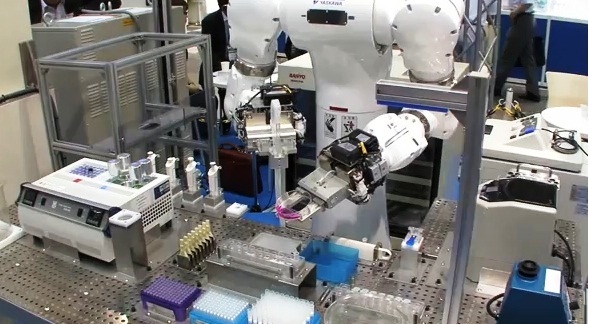
From Cnet.com; Video screenshot by Tim Hornyak/CNET
As I am running a lab myself and always hope to get more data, the second I saw the setup with the pipettes, PCR and dry baths, I could not stop thinking “wouldn’t it be nice to have one of these robots to work in the lab for 24 hours…. “.
Having a good science education is essential for all of us, because that trains one’s critical thinking; while asking a lot more students to join the field is a whole different issue. A number of factors comes into play for one to decide whether he would want to pursue this career, including one’s personality, dedication, and perhaps most importantly, financial status and career aspiration. As a teacher for many students who has spent a few more years than them and has gone through some of these thinking exercises, I believe it is rather important to let students know about the reality of the career path in research rather than telling them a rosy story and blindly motivating them. To me that is just like an academic Ponzi scheme.
Here is a great article “U.S. pushes for more scientists, but the jobs aren’t there” about the situation (once again), by Brian Vastag from the Washington Post:
That reality runs counter to messages sent by President Obama and the National Science Foundation and other influential groups, who in recent years have called for U.S. universities to churn out more scientists.
What worries me the most during the counseling of younger students, is that many think they study well, can get good grades and hence going to graduate school is a natural choice. My typical response is that “you don’t want to go to graduate school”. Don’t get me wrong. I am very enthusiastic in training students and motivate them about the excitements of scientific discoveries and thinking. However, I often see students, friends and colleagues who have good heart and can study well but ended up getting frustrated about the situation when they are a bit older and have more family obligations. I often give students a few analogies to help their planning. Here is of them, compare pursuing research as a career to pursuing performing arts (or artists or TV stars, you get the idea) as a career. Don’t just look at the successful ones for inspiration and commit yourself to the path. Also look at the ones that have to struggle for survival. If you like that kind of sacrifice for you and your family and uncertainties for the career satisfaction, may be pursuing research as a career is good for you. In other words, pursuing research as a career requires not only the smartest minds, but also the strongest dedication and good financial flexibility. Unless there is a fundamental change in the system, research is not the career type that would give the stability that many may have perceived.
Since our lab is studying retina, I am intrigued in reading this article about the limitation of retina display by Apple, how we see and the future of developing better displays.
From cultofmac by John Brownlee: Why Retina Isn’t Enough
Apple’s new MacBook Pro follows the fine tradition of the iPhone 4 and third-gen iPad in that it has a super high-resolution Retina display: a 2880 x 1800 panel with an amazing 220 pixels packed in per inch.
It’s an incredible display. In fact, it’s such an incredible display that it actually has about one million, seven hundred thousand pixels more than it needs to satisfy Apple’s definition of Retina, leading some to claim that those pixels are all going to waste.
Nothing could be further from the truth.
Apple’s new MacBook Pros have absolutely great displays, but they need every single pixel they have, because the truth of the matter is that Apple’s got a long way to go before it catches its display tech up to the incredible power of human vision. And that’s a good thing, because it means we’ve got a lot to look forward to.

From http://www.cultofmac.com
Development
Behaviour
Systems Biology
Human Microbiome
Retinal degeneration
Neuroscience
Retinal development