The genome sequence of the naked mole rat is published recently (Kim et al., 2011) ! This is an amazing creature that lives almost up to 30 years in captivity, 9 times longer than mice. At the same time they do not seem to suffer from cancer or a decline in fertility (Buffenstein 2008).
I have been fascinated by the research on the naked mole rats since I read an research article published by Vera Gorbunova’s group in 2009 (Seluanov et al., 2009). In this study, the authors elucidated the naturally occurred anti-cancer mechanism inside this creature. As it turns out, the cells from the naked mole rat will initiate a program to turn off cell growth as soon as the cells start touching each other in culture, a much earlier response than that in regular rats or mice. The most impressive finding is that this early program that can turn off cell growth actually uses the same cell division control mechanisms as in us, but it is just fine-tuned to respond to growth more sensitively. In the new study that sequenced the genome of the naked mole rat, a number of interesting findings have been found and may reveal other aspects of its longevity and physiology for this success and etc. I will save this for your own personal reading.
I find all these results beautiful and powerfully remind us how studying our nature can lead to potentially important findings that can “translate” to human health; and how the “traditional” clinical research on human and classical animal models can miss the answer that is already out there.
Extended readings
Buffenstein R. Negligible senescence in the longest living rodent, the naked mole-rat: insights from a successfully aging species. J Comp Physiol B. 2008 May;178(4):439-45. Epub 2008 Jan 8. Review. PubMed PMID: 18180931.
Kim EB et al., Genome sequencing reveals insights into physiology and longevity of the naked mole rat. Nature. 2011 Oct 12. doi: 10.1038/nature10533. [Epub ahead of print] PubMed PMID: 21993625.
Seluanov A et al., Hypersensitivity to contact inhibition provides a clue to cancer resistance of naked mole-rat. Proc Natl Acad Sci U S A. 2009 Nov 17;106(46):19352-7. Epub 2009 Oct 26. PubMed PMID: 19858485; PubMed Central PMCID: PMC2780760.
Lander AD. Pattern, growth, and control. Cell. 2011 Mar 18;144(6):955-69. Review. PubMed PMID: 21414486; PubMed Central PMCID: PMC3128888.
Braendle C, Felix MA. The other side of phenotypic plasticity: a developmental system that generates an invariant phenotype despite environmental variation. J Biosci. 2009 Oct;34(4):543-51. Review. PubMed PMID: 19920340.
Noordermeer D, Leleu M, Splinter E, Rougemont J, De Laat W, Duboule D. The dynamic architecture of Hox gene clusters. Science. 2011 Oct 14;334(6053):222-5. PubMed PMID: 21998387.
Genomics
Sadeh R, Allis CD. Genome-wide “Re”-Modeling of Nucleosome Positions. Cell. 2011 Oct 14;147(2):263-6. PubMed PMID: 22000006.
Lupski JR, Belmont JW, Boerwinkle E, Gibbs RA. Clan genomics and the complex architecture of human disease. Cell. 2011 Sep 30;147(1):32-43. PubMed PMID: 21962505.
Raychaudhuri S. Mapping rare and common causal alleles for complex human diseases. Cell. 2011 Sep 30;147(1):57-69. PubMed PMID: 21962507; PubMed Central PMCID: PMC3198013.
Genetics
Cesana M, Cacchiarelli D, Legnini I, Santini T, Sthandier O, Chinappi M, Tramontano A, Bozzoni I. A long noncoding RNA controls muscle differentiation by functioning as a competing endogenous RNA. Cell. 2011 Oct 14;147(2):358-69. PubMed PMID: 22000014.
Funding
Mervis J. Peer review. Beyond the data. Science. 2011 Oct 14;334(6053):169-71. PubMed PMID: 21998363.
Systems biology
Liu C, Fu X, Liu L, Ren X, Chau CK, Li S, Xiang L, Zeng H, Chen G, Tang LH, Lenz P, Cui X, Huang W, Hwa T, Huang JD. Sequential establishment of stripe patterns in an expanding cell population. Science. 2011 Oct 14;334(6053):238-41. PubMed PMID: 21998392.
Medical research
Novarino G, Akizu N, Gleeson JG. Modeling human disease in humans: the ciliopathies. Cell. 2011 Sep 30;147(1):70-9. PubMed PMID: 21962508.
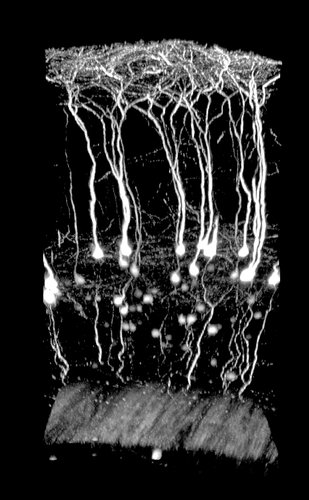
The other day my colleague Don Ready in the department forwarded an interesting news article from The New York Times that describes a very simple mountant to makes tissue samples very transparent without affecting the fluorescence signal. That substantially helps imaging thick samples. The technique, which is called Scale, is published in Nature Neuroscience.
A 3d reconstruction of neurons labeled by fluorescent protein in mouse brain treated with Scale; Provided by Atsushi Miyawaki to the New York Times
The most interesting aspect about Scale is that it is made up with cheap chemicals that one can find in the lab (urea, glycerol and triton-X 100). It was actually discovered by a random but careful observation in the lab. That makes me wonder how much we have missed every time when we follow a protocol “religiously”.
Filed in Fai's sharing, imaging||Comments Off on A simple mountant that makes embryo transparent
I have never got a chance to listen to this famous speech by Steve Jobs and have finally listened to it because of all the recently coverages after he has passed away. It is actually quite insightful and I would like to share with all of you.
I am actually quite interested in his upcoming biography, which has already triggered some interesting discussions. For example, read Steve Jobs Bio: Its 6 Most Surprising Reveals from Wired.com.
Filed in Fai's sharing||Comments Off on Steve Jobs Stanford Commencement Speech 2005
Roebber PJ, Schultz DM. Peer review, program officers and science funding. PLoS One. 2011 Apr 12;6(4):e18680. PubMed PMID: 21533268; PubMed Central PMCID: PMC3075261.
The most interesting conclusion is – the best strategy is to submit more applications when funding rate drops below 15%.
Neuroscience
Peelen MV, Kastner S. Is that a bathtub in your kitchen? Nat Neurosci. 2011 Sep 27;14(10):1224-6. doi: 10.1038/nn.2936. PubMed PMID: 21952264.
Genomics
Adli M, Bernstein BE. Whole-genome chromatin profiling from limited numbers of cells using nano-ChIP-seq. Nat Protoc. 2011 Sep 29;6(10):1656-68. doi: 10.1038/nprot.2011.402. PubMed PMID: 21959244.
Keller A, Leidinger P, Bauer A, Elsharawy A, Haas J, Backes C, Wendschlag A, Giese N, Tjaden C, Ott K, Werner J, Hackert T, Ruprecht K, Huwer H, Huebers J, Jacobs G, Rosenstiel P, Dommisch H, Schaefer A, Müller-Quernheim J, Wullich B, Keck B, Graf N, Reichrath J, Vogel B, Nebel A, Jager SU, Staehler P, Amarantos I, Boisguerin V, Staehler C, Beier M, Scheffler M, Büchler MW, Wischhusen J, Haeusler SF, Dietl J, Hofmann S, Lenhof HP, Schreiber S, Katus HA, Rottbauer W, Meder B, Hoheisel JD, Franke A, Meese E. Toward the blood-borne miRNome of human diseases. Nat Methods. 2011 Sep 4;8(10):841-3. doi: 10.1038/nmeth.1682. PubMed PMID: 21892151.
Development/ Stem cells
Friedrich Ben-Nun I, Montague SC, Houck ML, Tran HT, Garitaonandia I, Leonardo TR, Wang YC, Charter SJ, Laurent LC, Ryder OA, Loring JF. Induced pluripotent stem cells from highly endangered species. Nat Methods. 2011 Sep 4;8(10):829-31. doi: 10.1038/nmeth.1706. PubMed PMID: 21892153.
Pera MF. The proteomes of native and induced pluripotent stem cells. Nat Methods. 2011 Sep 29;8(10):807-8. doi: 10.1038/nmeth.1707. PubMed PMID: 21959134.
Genetics/ Optogenetics
Toettcher JE, Gong D, Lim WA, Weiner OD. Light-based feedback for controlling intracellular signaling dynamics. Nat Methods. 2011 Sep 11;8(10):837-9. doi: 10.1038/nmeth.1700. PubMed PMID: 21909100.
Commentary: Haugh JM. Cells see the light to bring signaling under control. Nat Methods. 2011 Sep 29;8(10):808-9. doi: 10.1038/nmeth.1708. PubMed PMID: 21959135.
Imaging
Ghosh KK, Burns LD, Cocker ED, Nimmerjahn A, Ziv Y, Gamal AE, Schnitzer MJ. Miniaturized integration of a fluorescence microscope. Nat Methods. 2011 Sep 11;8(10):871-8. doi: 10.1038/nmeth.1694. PubMed PMID: 21909102.
Systems Biology/ Gene Regulatory Network
Foss EJ, Radulovic D, Shaffer SA, Goodlett DR, Kruglyak L, Bedalov A. Genetic Variation Shapes Protein Networks Mainly through Non-transcriptional Mechanisms. PLoS Biol. 2011 Sep;9(9):e1001144. Epub 2011 Sep 6. PubMed PMID: 21909241; PubMed Central PMCID: PMC3167781.
Splinter E, de Laat W. The complex transcription regulatory landscape of our genome: control in three dimensions. EMBO J. 2011 Sep 27. doi: 10.1038/emboj.2011.344. [Epub ahead of print] PubMed PMID: 21952046.
Lynch VJ, Leclerc RD, May G, Wagner GP. Transposon-mediated rewiring of gene regulatory networks contributed to the evolution of pregnancy in mammals. Nat Genet. 2011 Sep 25. doi: 10.1038/ng.917. [Epub ahead of print] PubMed PMID:
21946353.
Garg A, Mohanram K, De Micheli G, Xenarios I. Implicit methods for qualitative modeling of gene regulatory networks. Methods Mol Biol. 2012;786:397-443. PubMed PMID: 21938638.
Brg1
Hu G, Schones DE, Cui K, Ybarra R, Northrup D, Tang Q, Gattinoni L, Restifo NP, Huang S, Zhao K. Regulation of nucleosome landscape and transcription factor targeting at tissue-specific enhancers by BRG1. Genome Res. 2011 Aug 31. [Epub ahead of print] PubMed PMID: 21795385.
Retina
Qin Z, Kidd AR 3rd, Thomas JL, Poss KD, Hyde DR, Raymond PA, Thummel R. FGF signaling regulates rod photoreceptor cell maintenance and regeneration in zebrafish. Exp Eye Res. 2011 Sep 17. [Epub ahead of print] PubMed PMID: 21945172.
Dal Molin M, Hong SM, Hebbar S, Sharma R, Scrimieri F, de Wilde R, Mayo SC, Goggins M, Wolfgang CL, Schulick RD, Lin MT, Eshleman JR, Hruban RH, Maitra A, Matthaei H. Loss of expression of the SWI/SNF chromatin remodeling subunit
BRG1/SMARCA4 is frequently observed in intraductal papillary mucinous neoplasms of the pancreas. Hum Pathol. 2011 Sep 20. [Epub ahead of print] PubMed PMID: 21940037.
Update 1: On 10/13/2011, our lab had a journal club on one of the original key publications – Steinman RM, Witmer MD. Lymphoid dendritic cells are potent stimulators of the primary mixed leukocyte reaction in mice. Proc Natl Acad Sci U S A. 1978 Oct;75(10):5132-6. PubMed PMID: 154105; PubMed Central PMCID: PMC336278.
Update 2: Ralph Steinman passed away the Friday before the prize announcement. There are a few interesting news articles on his hard work until the final days and effort on designing new therapies based on his discovery.
Ramachandran R, Zhao XF, Goldman D. Ascl1a/Dkk/{beta}-catenin signaling pathway is necessary and glycogen synthase kinase-3{beta} inhibition is sufficient for zebrafish retina regeneration. Proc Natl Acad Sci U S A. 2011 Sep 20;108(38):15858-63. Epub 2011 Sep 12. PubMed PMID: 21911394.
Zupanc GK, Sîrbulescu RF. Adult neurogenesis and neuronal regeneration in the central nervous system of teleost fish. Eur J Neurosci. 2011 Sep;34(6):917-29. doi: 10.1111/j.1460-9568.2011.07854.x. PubMed PMID: 21929625.
Zebrafish
Zhu C, Smith T, McNulty J, Rayla AL, Lakshmanan A, Siekmann AF, Buffardi M, Meng X, Shin J, Padmanabhan A, Cifuentes D, Giraldez AJ, Look AT, Epstein JA, Lawson ND, Wolfe SA. Evaluation and application of modularly assembled zinc-finger nucleases in zebrafish. Development. 2011 Oct;138(20):4555-64. PubMed PMID: 21937602.
Ageing
* A series of articles on the validity of sir2’s role in longevity.
Burnett C, Valentini S, Cabreiro F, Goss M, Somogyvári M, Piper MD, Hoddinott M, Sutphin GL, Leko V, McElwee JJ, Vazquez-Manrique RP, Orfila AM, Ackerman D, Au C, Vinti G, Riesen M, Howard K, Neri C, Bedalov A, Kaeberlein M, Soti C, Partridge L, Gems D. Absence of effects of Sir2 overexpression on lifespan in C. elegans and Drosophila. Nature. 2011 Sep 21;477(7365):482-5. doi: 10.1038/nature10296. PubMed PMID: 21938067.
Viswanathan M, Guarente L. Regulation of Caenorhabditis elegans lifespan by sir-2.1 transgenes. Nature. 2011 Sep 21;477(7365):E1-2. doi: 10.1038/nature10440. PubMed PMID: 21938026.
Zhang L, Hou D, Chen X, Li D, Zhu L, Zhang Y, Li J, Bian Z, Liang X, Cai X, Yin Y, Wang C, Zhang T, Zhu D, Zhang D, Xu J, Chen Q, Ba Y, Liu J, Wang Q, Chen J, Wang J, Wang M, Zhang Q, Zhang J, Zen K, Zhang CY. Exogenous plant MIR168a specifically targets mammalian LDLRAP1: evidence of cross-kingdom regulation by microRNA. Cell Res. 2011 Sep 20. doi: 10.1038/cr.2011.158. [Epub ahead of print] PubMed PMID: 21931358.
Plant miRNA can get into human by food consumption and affect physiological response!
Whiteley AR, Bhat A, Martins EP, Mayden RL, Arunachalam M, Uusi-Heikkilä S, Ahmed AT, Shrestha J, Clark M, Stemple D, Bernatchez L. Population genomics of wild and laboratory zebrafish (Danio rerio). Mol Ecol. 2011 Sep 16. doi: 10.1111/j.1365-294X.2011.05272.x. [Epub ahead of print] PubMed PMID: 21923777.
Catchen JM, Braasch I, Postlethwait JH. Conserved synteny and the zebrafish genome. Methods Cell Biol. 2011;104:259-85. PubMed PMID: 21924168.
Filed in journal watch||Comments Off on 2011-10-01 new articles we read this week