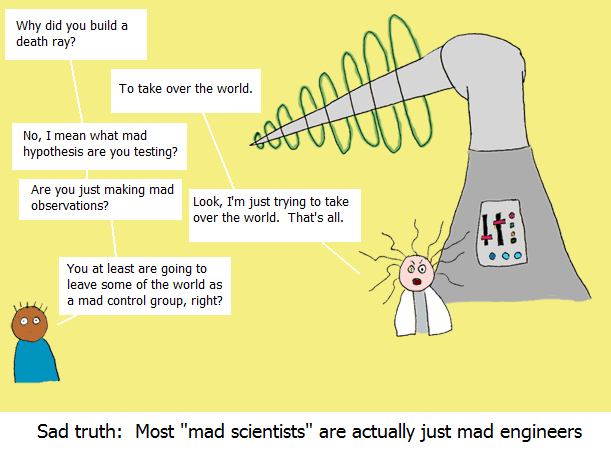
These days many cherish “hypothesis-driven” research and trash everything that is observational, exploratory and non-translational. And yet the hypothesis in many research is “post-research” hypothesis. The “hypothesis” itself is also often generated for the sake of having an hypothesis; the essence of the research can still be exploratory.
So when funding is getting scarce and the pressure of coming up with beautiful hypothesis is mounting, one must ask what the value of hypothesis-driven research is. Is it the only way to get important findings? Is it delivering more than other “inferior” approaches?
As I am thinking about these questions and situation all the time, I am leading a journal club in the lab on 8/1 and trying to discuss the philosophical aspects of this with my lab members. And I want to write this down and have a record before we do so. We will read a few articles:
- Pisani E. Has the internet changed science? Prospect 2010; 177:54 [pdf]
- Kell DB, Oliver SG. Here is the evidence, now what is the hypothesis? The complementary roles of inductive and hypothesis-driven science in the post-genomic era. Bioessays. 2004 Jan;26(1):99-105. PubMed PMID: 14696046.
- Ioannidis JP. Why most published research findings are false. PLoS Med. 2005 Aug;2(8):e124. Epub 2005 Aug 30. PubMed PMID: 16060722; PubMed Central PMCID: PMC1182327.
and discuss a few questions, in addition to the ones I have above:
- Are data mining or descriptive research useless?
- What are the downsides of doing “hypothesis-driven research”?
- Are we/funding agencies/authorities doing the society a favor by insisting scientists to have a hypothesis/justification attached to a research idea? how about research that has translational value (i.e. curing disease)? or technical value (e.g. developing a cheaper and faster way to sequence human genome?)
- Is/Can there a balance between different scientific research approaches?
Animal model
- Aitman TJ, Boone C, Churchill GA, Hengartner MO, Mackay TF, Stemple DL. The future of model organisms in human disease research. Nat Rev Genet. 2011 Jul18;12(8):575-82. doi: 10.1038/nrg3047. PubMed PMID: 21765459.
- Thomas JL, Vihtelic TS, Dendekker AD, Willer G, Luo X, Murphy TR, Gregg RG, Hyde DR, Thummel R. The loss of vacuolar protein sorting 11 (vps11) causes retinal pathogenesis in a vertebrate model of syndromic albinism. Invest Ophthalmol Vis Sci. 2011 May 27. [Epub ahead of print] PubMed PMID: 21622697.
Systems biology
- Garcia HG, Phillips R. Quantitative dissection of the simple repression input-output function. Proc Natl Acad Sci U S A. 2011 Jul 19;108(29):12173-8.Epub 2011 Jul 5. PubMed PMID: 21730194.
- Schmidt A, Beck M, Malmström J, Lam H, Claassen M, Campbell D, Aebersold R. Absolute quantification of microbial proteomes at different states by directed mass spectrometry. Mol Syst Biol. 2011 Jul 19;7:510. doi: 10.1038/msb.2011.37. PubMed PMID: 21772258.
- Dahan O, Gingold H, Pilpel Y. Regulatory mechanisms and networks couple the different phases of gene expression. Trends Genet. 2011 Jul 13. [Epub ahead of print] PubMed PMID: 21763027.
Retinal development
- Brzezinski JA 4th, Kim EJ, Johnson JE, Reh TA. Ascl1 expression defines a subpopulation of lineage-restricted progenitors in the mammalian retina.Development. 2011 Jul 19. [Epub ahead of print] PubMed PMID: 21771810.
Ethics, Legal and Social Issues
- Dresser R. Families and forensic DNA profiles. Hastings Cent Rep. 2011 May-Jun;41(3):11-2. PubMed PMID: 21678805.
- Nelson L, Ashby B. Rethinking the ethics of physician participation in lethal injection execution. Hastings Cent Rep. 2011 May-Jun;41(3):28-37. PubMed PMID: 21678813.
Delta-Notch, signal transduction
- Ohata S, Aoki R, Kinoshita S, Yamaguchi M, Tsuruoka-Kinoshita S, Tanaka H, Wada H, Watabe S, Tsuboi T, Masai I, Okamoto H. Dual roles of Notch in regulation of apically restricted mitosis and apicobasal polarity of neuroepithelial cells. Neuron. 2011 Jan 27;69(2):215-30. PubMed PMID: 21262462.
Ethical, Legal and Social Issues
- Mismeasure for mismeasure. Nature. 2011 Jun 22;474(7352):419. doi: 10.1038/474419a. PubMed PMID: 21697903.
- Lewis JE, Degusta D, Meyer MR, Monge JM, Mann AE, Holloway RL. The Mismeasure of Science: Stephen Jay Gould versus Samuel George Morton on Skulls and Bias. PLoS Biol. 2011 Jun;9(6):e1001071. Epub 2011 Jun 7. PubMed PMID: 21666803; PubMedCentral PMCID: PMC3110184.
- Ioannidis JP. Why most published research findings are false. PLoS Med. 2005 Aug;2(8):e124. Epub 2005 Aug 30. PubMed PMID: 16060722; PubMed Central PMCID:PMC1182327.
Gene regulatory network
- Amit R, Garcia HG, Phillips R, Fraser SE. Building enhancers from the ground up: a synthetic biology approach. Cell. 2011 Jul 8;146(1):105-18. PubMed PMID: 21729783.
- Frankel N, Erezyilmaz DF, McGregor AP, Wang S, Payre F, Stern DL. Morphological evolution caused by many subtle-effect substitutions in regulatory DNA. Nature. 2011 Jun 29;474(7353):598-603. doi: 10.1038/nature10200. PubMedPMID: 21720363.
- Peter IS, Davidson EH. A gene regulatory network controlling the embryonic specification of endoderm. Nature. 2011 May 29;474(7353):635-9. doi: 10.1038/nature10100. PubMed PMID: 21623371.
Neurobiology
- Xiao T, Staub W, Robles E, Gosse NJ, Cole GJ, Baier H. Assembly of Lamina-Specific Neuronal Connections by Slit Bound to Type IV Collagen. Cell.2011 Jul 8;146(1):164-76. PubMed PMID: 21729787.
Zebrafish
- Lauter G, Söll I, Hauptmann G. Two-color fluorescent in situ hybridization in the embryonic zebrafish brain using differential detection systems. BMC Dev Biol. 2011 Jul 4;11:43. PubMed PMID: 21726453.
http://discovermagazine.com/2011/apr/20-things-you-didnt-know-about-dna
From If the dog ate your homework, read this:
There are always excuses for not showing up, or not turning work in. I’ve heard them all. But lives built on excuses generally don’t turn out well.
Few people care whether you succeed or fail. You are not showing up to class for your teachers or even your parents. You’re not doing these assignments for anyone but yourselves.
Life has a way of getting serious with us well before some of us decide to get serious with it. By that time, it may be too late to build the life you might have wanted.
An interesting article “Positive Black Swans” by Tim Harford From Slate
Still, after a few years, Capecchi had decided that Harvard was not for him. Despite great resources, inspiring colleagues and a supportive mentor in Watson, he found the Harvard environment demanded results in too much of a hurry. That was fine, if you wanted to take predictable steps along well-signposted pathways. But Capecchi felt that if you wanted to do great work, to change the world, you had to give yourself space to breathe. Harvard, he thought, had become “a bastion of short-term gratification.” Off he went instead to the University of Utah, where a brand-new department was being set up. He had spotted, in Utah, a Galapagan island on which to develop his ideas.
Mario Capecchi developed the approach for generating knock0ut mice and received the Nobel Prize in Physiology or Medicine 2007.